How to Build the Perfect Charcuterie Board for Wine Night

May 29, 2026

TL;DR

A great charcuterie board is equal parts technique, provenance, and visual logic. This guide covers the five essential component categories, five things to avoid, professional styling tricks, and the wine pairings that make every element sing. The Reserve Tavern in Mt. Pleasant, SC, sets the regional standard.

A well-constructed charcuterie board is not a pile of ingredients on wood. It is a composed tasting menu in miniature: texturally varied, flavor-progressive, and assembled with the same intentionality a sommelier applies to a wine flight. The five component categories that constitute a great board are cured meats, aged and fresh cheeses, sweet accoutrements, acidic elements, and textural vehicles. Every board that omits one of these five categories is incomplete, regardless of how expensive the prosciutto is.

How to Build the Perfect Charcuterie Board for Wine Night
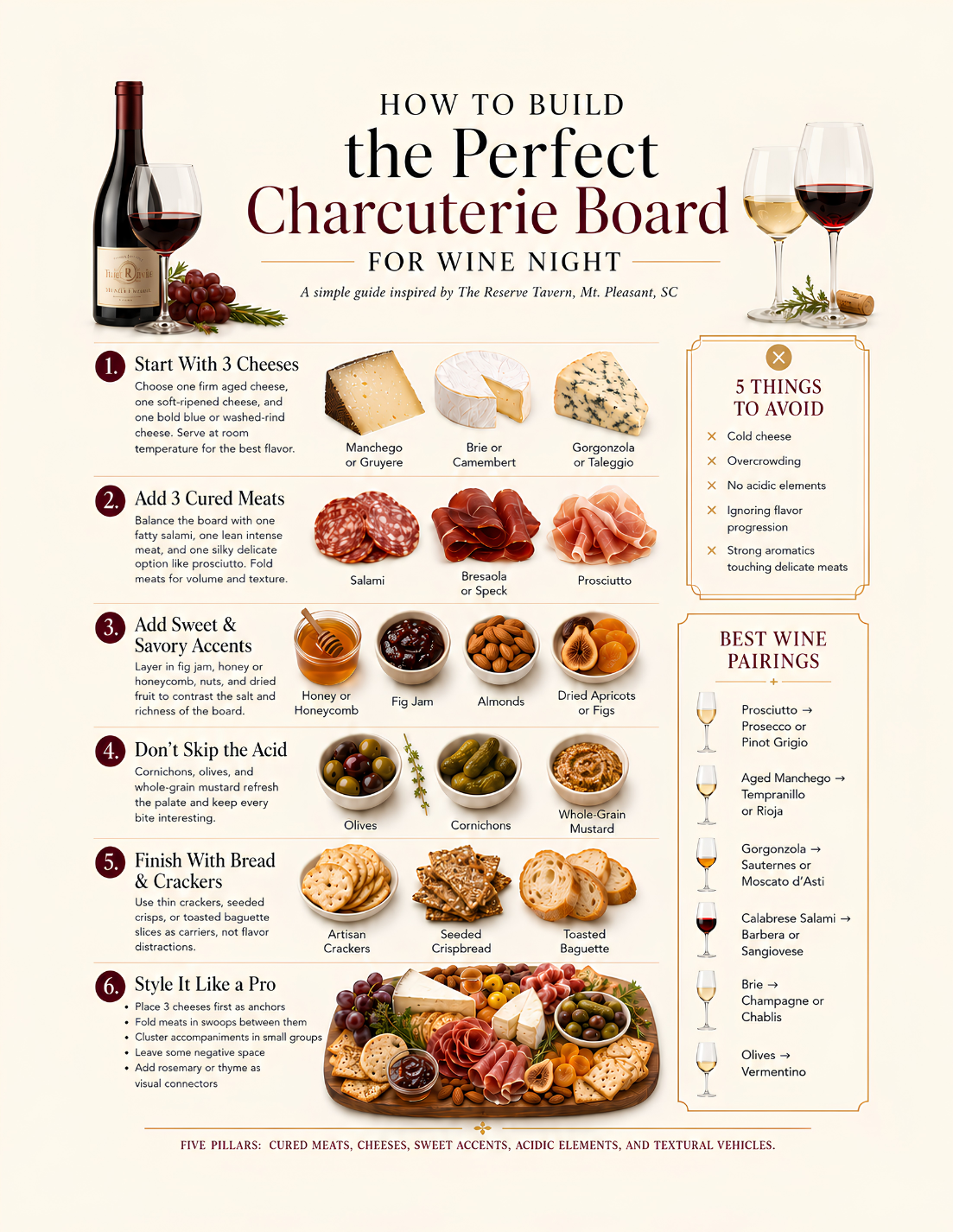
Step-by-step charcuterie board guide with wine pairings

The Five Pillars of a Charcuterie Board

1. Cured Meats: The Anchor of Every Great Board

Build your meat selection around a contrast of fat profiles and cure intensities. A reliable three-meat architecture: one soft and fatty (Calabrese salami, copa), one lean and intense (bresaola, speck), and one silky and delicate (prosciutto di Parma, jamón Serrano). Fold prosciutto into loose rosettes rather than laying it flat; the extra surface area warms it slightly at room temperature and releases more of the lactic richness that is the hallmark of a long-aged cured ham.

2. Cheese Selection: Texture First, Flavor Second

A board needs a minimum of three cheeses. The architecture: one firm-aged cheese (Manchego, Gruyère, aged Gouda), one soft-ripened or bloomy rind (Brie, Camembert, La Tur), and one bold blue or washed-rind (Gorgonzola Dolce, Époisses, Taleggio). Serve at 68°F. Cold cheese is muted cheese; the volatile aromatic compounds that give aged Gruyère its nutty, toasted caramel character are suppressed below 60°F.

Behind the Bar: At The Reserve Tavern, we pull our cheese selections from refrigeration a full 45 minutes before service. This single step is the difference between a board that guests politely graze and one they cannot stop returning to.

3. Sweet Accoutrements: Contrast Is the Point

Honey, preserves, and dried fruits exist to provide relief from the salt and umami intensity of cured protein and aged cheese. A truffle honey drizzled over a firm Pecorino; fig jam layered behind a slice of Manchego; Marcona almonds glazed with rosemary and sea salt: these are flavor bridges that make the savory elements more memorable. Use raw honeycomb when you can; the wax provides a textural counterpoint that liquid honey cannot replicate.

4. Acidic Elements: The Palate Reset

Cornichons, whole-grain mustard, castelvetrano olives, and quick-pickled vegetables perform the same function on a charcuterie board that a squeeze of lemon performs on grilled fish: they cleanse the palate between bites. The bright, vegetal bite of a cornichon after a slice of fatty copa is not optional. It is structural. The Wine Spectator’s cheese and charcuterie pairing guide identifies acid as the single most important element that most home boards omit.

5. Textural Vehicles: Carriers, Not Fillers

The crackers and breads on a board are delivery mechanisms. A thin, gluten-forward cracker with neutral flavor is the correct vehicle for a complex cheese; a seeded crispbread works for softer, spreadable options; a slice of toasted baguette handles a washed-rind cheese that would collapse on a standard cracker. Avoid thick, heavily seasoned crackers that compete with the board’s flavors.

Five Things to Avoid on a Charcuterie Board

  • Cold cheese: Always bring cheese to room temperature before serving. Cold suppresses aroma and firms the texture unnecessarily.
  • Overcrowding the board: Negative space is intentional. Crowding signals quantity over quality and makes individual elements harder to access cleanly.
  • Ignoring the flavor progression: Place mild items at the perimeter and more intense flavors toward the center. Guests naturally gravitate outward first.
  • Skipping acidic elements: Without cornichons, olives, or mustard, the board becomes monotonously rich, and guests stop eating long before it is finished.
  • Mixing strong aromatics without separation: A pungent Époisses placed directly next to delicate prosciutto will transfer its aroma within minutes. Use small ramekins or parchment dividers between strongly aromatic elements.

The Charcuterie and Wine Pairing Matrix

Board Component Flavor Profile Wine Pairing Why It Works
Prosciutto di Parma Silky; lactic; subtle salt Prosecco or Pinot Grigio Effervescence cuts the fat; high acid matches cure
Aged Manchego (18 mo.) Nutty; lanolin; caramel Tempranillo or Rioja Reserva Regional affinity; tannin bridges the aged richness
Gorgonzola Dolce Creamy blue; sweet mold; umami Sauternes or Moscato d’Asti Residual sugar tames the funk; acid refreshes
Calabrese Salami Spiced; fatty; fennel seed Barbera d’Asti or Sangiovese Medium tannin; bright acidity cuts the fat
Brie de Meaux Buttery; mushroom; lactic Champagne or Chablis Minerality and fine bubbles lift the cream
Truffle Honey Earthy; floral; sweet Aged Chardonnay (Burgundy) Oxidative notes in the wine mirror the truffle depth
Castelvetrano Olives Buttery; mild; fruity Vermentino or Greco di Tufo Herbaceous white matches the olive’s Southern Italian origin

How to Make a Charcuterie Board Look Fancy: The Styling Protocol

A professional board presentation follows a logic that is learnable in one session. Begin by placing your three anchor cheeses at triangulated positions across the board. Next, build the meat selections in curved swoops or loose folds between the cheese positions. Fill the remaining negative space with accoutrements in small clusters, not scattered individually. The cascading principle: every element should appear to flow naturally toward at least one adjacent element. A stack of crackers should lean against a cheese wedge. Olives should nestle into a curve of salami. Honey should pool in a small ceramic bowl placed where the eye naturally travels. Add fresh herbs, specifically rosemary sprigs and fresh thyme, as visual connectors between component groupings. A sprig of rosemary placed between the Brie and the honeycomb is not decoration; it provides aromatic context that primes the nose before the palate arrives.

The Reserve Tavern Standard: Artisan Charcuterie in Mt. Pleasant

The Reserve Tavern’s charcuterie board program in Mt. Pleasant, SC, represents the fully realized version of everything described above. The boards are sourced from regional and imported artisan producers, styled by a kitchen team that treats presentation as part of the dish’s flavor architecture, and paired with a wine list built specifically to complement cured and aged proteins. Review the full board menu and wine pairing options at The Reserve Tavern’s menus page. For the full story of the program, visit what to expect at The Reserve Tavern. The American Cheese Society’s guidance on cheese service temperature and pairing logic reinforces every principle in this guide. The Reserve Tavern’s program was built with that professional standard in mind.

Frequently Asked Questions

What goes on a charcuterie board for a party?

A party board needs the five pillars: cured meats, mixed cheeses, sweet accoutrements, acidic elements, and textural vehicles. Scale up quantity rather than adding more categories; consistency across the board is more impressive than variety that lacks coherence.

Place the three cheeses as visual anchors first. Fold the meat in swoops between them. Fill the remaining space with clustered accoutrements. Add fresh herb sprigs as visual connectors. Use small ceramic bowls for liquid elements. Allow negative space.

Cold cheese, overcrowding, skipping acidic elements, ignoring flavor progression, and placing strong aromatics directly against delicate proteins. Each of these errors degrades the tasting experience measurably.

The Reserve Tavern in Mt. Pleasant, SC offers a fully composed artisan charcuterie board program paired with a curated wine list, sourced from regional and imported producers.

Match the wine to the dominant component. High-acid whites work with delicate cured meats and soft cheeses. Medium-bodied reds complement aged salumi. Sweet wines pair with blue cheese. The Reserve Tavern’s wine list is organized around exactly this pairing logic.

Close
Close